 Türkçe
 Deutsch
Pre-Accounting vs General Accounting: What Is the Difference?
Pre-accounting tracks invoices, customer accounts, cash, bank and stock document by document; general accounting posts the same transactions to the statutory books with Türkiye’s Uniform Chart of Accounts. We explain the differences, how one transaction looks on both sides and which one your business needs.
Pre-Accounting and General Accounting in Brief
Pre-accounting (ön muhasebe in Turkish, also called day-to-day bookkeeping) is the recording and tracking of a business’s daily commercial transactions: invoices issued and received, customer and supplier accounts, receipts, payments, cash, bank, cheques and notes, stock. The questions it answers are for the business itself: Who owes us how much? What do we have to pay, and to whom? What is in the till and in the bank? How many of each product are left in the warehouse?
General accounting is the posting of these transactions to the statutory books using double-entry bookkeeping and Türkiye’s Uniform Chart of Accounts. What it produces is for the law and the tax office: the journal, the general ledger, the trial balance, the balance sheet, the income statement and the figures behind the tax returns.
The two are not alternatives. Pre-accounting records are the source of general accounting; general accounting rewrites the same transactions in the language of ledger accounts. In this article you will find what each side does, how they differ, how the same transaction looks on both sides and which one your business needs. Legal obligations differ from business to business, so confirm your own situation with your accountant.
What Is Pre-Accounting?
Pre-accounting runs on documents. Behind every record there is a document: an invoice, a delivery note, a receipt, a bank advice, an expense slip, a cheque. Records are entered when the transaction happens, usually by the person doing the work: the salesperson issues the invoice, the finance officer records the receipt, the warehouse keeper enters the stock count.
Typical pre-accounting tasks are:
- Customer and supplier accounts: What each customer and supplier owes or is owed, with due dates and statements.
- Invoices and delivery notes: Sales and purchase invoices, e-invoices and e-archive invoices, delivery notes.
- Receipts and payments: Cash and bank transactions, card payments, cheques and notes.
- Expenses: Rent, fuel, stationery and other costs recorded with their documents.
- Stock: How much of each product was bought, sold and is left in the warehouse.
- Reports: Overdue receivables, cash flow, cash and bank balances, VAT totals.
Pre-accounting is not a statutory book in itself. But the invoices and other documents it is based on are legal documents, and well-kept pre-accounting records are what make general accounting correct.
What Is General Accounting?
General accounting works through accounts. Each transaction becomes an accounting voucher in which at least one account is debited and at least one credited, and both sides add up to the same amount. A sales invoice goes to 120 Trade receivables, 600 Domestic sales and 391 Calculated VAT; a receipt to 102 Banks and 120 Trade receivables. We explained in detail which transaction goes to which account, and why, in our article on journal entry examples.
Vouchers are entered in date order in the journal and account by account in the general ledger (defteri kebir). From these come the trial balance and, at the end of the period, the balance sheet and income statement. The figures for VAT, withholding, provisional tax and annual tax returns come from here too. In most businesses general accounting is done by a certified public accountant (SMMM); in large ones by the company’s own accounting department.
How the books are kept is also regulated: paper books are certified by a notary, and businesses that meet certain conditions keep their books as an e-Ledger (e-Defter) and upload the certificates to the Revenue Administration (GİB). At year end the cost, income and expense accounts are closed; you will find the steps in our article year-end closing step by step.
Differences Between Pre-Accounting and General Accounting
| Topic | Pre-accounting | General accounting |
|---|---|---|
| Purpose | Day-to-day tracking: receivables, payables, cash, stock | Statutory books, financial statements and tax returns |
| Who does it? | The business itself: sales, finance, warehouse | An accountant or the company’s accounting department |
| Unit of record | A document: invoice, receipt, bank advice, expense slip | An accounting voucher: debit and credit lines |
| Structure used | Customer, cash, bank and product cards | Uniform Chart of Accounts: 100 Cash, 120 Trade receivables, 600 Domestic sales… |
| When? | When the transaction happens | Mostly periodically: at month end, before tax returns |
| Outputs | Customer statements, overdue receivables, cash and bank balances, stock levels, cash flow | Journal, general ledger, trial balance, balance sheet, income statement |
| Legal status | Not a statutory book; the documents behind it are legal documents | Mandatory on the balance-sheet basis; books are certified or kept as an e-Ledger |
| If it goes wrong | Wrong customer balances, forgotten receipts, missing stock | Wrong financial statements, incorrect tax returns and the risk of tax penalties |
In short, pre-accounting records “what happened?” document by document, and general accounting answers “how did this affect the business’s financial position?” account by account.
How Does the Same Transaction Look on Both Sides?
Ten products were sold to a customer for TRY 40,000 plus TRY 8,000 VAT; the products cost TRY 30,000. Two weeks later the customer paid the TRY 48,000 by bank transfer.
| Record | What happens? |
|---|---|
| Sales invoice | TRY 48,000 is debited to the customer’s account and its due date starts. Ten products leave the warehouse. The invoice’s TRY 8,000 VAT goes into the VAT report. |
| Incoming transfer | TRY 48,000 is recorded as coming into the bank account. The customer’s balance goes to zero and the invoice is closed. |
| Voucher | Account | Debit | Credit |
|---|---|---|---|
| Sales invoice | 120 Trade receivables | 48,000 | |
| 600 Domestic sales | 40,000 | ||
| 391 Calculated VAT | 8,000 | ||
| Cost of goods sold | 621 Cost of trade goods sold | 30,000 | |
| 153 Trade goods | 30,000 | ||
| Receipt | 102 Banks | 48,000 | |
| 120 Trade receivables | 48,000 |
Both sides tell the same story in different languages. Pre-accounting says “the customer owes us TRY 48,000”; general accounting says “the customer’s account under 120 Trade receivables has a debit balance of TRY 48,000”. These two figures must always be the same. The decrease in stock in pre-accounting is the decrease in 153 in general accounting, and the profit on the sale is the difference between 600 and 621: a gross profit of TRY 10,000.
Which Books Do You Have to Keep?
Whether you need general accounting depends largely on the basis on which you keep your books:
| Business | Books | General accounting |
|---|---|---|
| Commercial companies such as limited and joint-stock companies | Balance-sheet basis: journal, general ledger, inventory book | Required |
| Sole proprietorships whose purchases, sales or turnover exceed the legal thresholds | Balance-sheet basis | Required |
| Sole proprietorships below these thresholds | Operating account basis: operating account book (işletme defteri) | Not required; income and expenses are recorded |
| Self-employed professionals | Self-employment earnings book (serbest meslek kazanç defteri) | Not required; revenue and expenses are recorded |
The operating account book and the self-employment earnings book are now kept in GİB’s Book-Declaration System (Defter-Beyan Sistemi). These books work as income and expense lists; there is no chart of accounts, no double-entry bookkeeping and no balance sheet. The thresholds that decide the class are updated every year; agree with your accountant which basis applies to your business.
Pre-accounting, on the other hand, is needed in every business, whatever its books. A shopkeeper keeping an operating account book still has to know who owes what, what is owed to suppliers and what is left in the warehouse; none of this appears in the operating account book.
How Do Pre-Accounting and General Accounting Work Together?
The two sides usually come together in one of two ways:
- Separate programs: The business keeps its pre-accounting in its own program. At month end, invoices, bank transactions and expense documents are sent to the accountant, who imports them into their own program or enters them again. The same transaction is recorded twice, the trial balance is ready days or weeks after the month ends, and the two programs can show different balances. Customer, cash and bank balances then have to be compared with the books every month.
- One program: Accounting vouchers are created from the pre-accounting records. A transaction is entered once; the voucher stays linked to its source, and you can go from the record to the voucher and back. The customer’s balance and the balance of its ledger account come from the same record, so they always agree. The accountant can look at the same records too.
Whichever way you work, these habits make month end easier:
- Pass documents on during the month. Invoices and expense documents that pile up until the last day delay both the tax returns and the trial balance. For the filing dates, see our article on the tax and SGK calendar.
- Compare balances. The cash count should match the cash account, the bank statement the bank account, and customer and supplier statements the sub-accounts under 120 and 320.
- Keep expenses and stock apart. Entering purchases that will not be resold as products in pre-accounting inflates stock and understates expenses in general accounting.
- Count your stock. The year-end count checks both the quantities in pre-accounting and the 153 balance in the books.
Pre-Accounting and General Accounting in Noyax
In Noyax, pre-accounting and general accounting are in the same program. On the pre-accounting side are customers, invoices and e-documents, delivery notes, stock, cash, bank, cheques and notes, and expenses. Overdue debtors, cash flow and cash and bank balances come from these records; the details are on our finance management page.
General accounting is added as a separate module and builds the accounting vouchers from the pre-accounting records. The Accounting › Posting screen collects unposted records on four tabs: invoices, cost of goods sold (COGS), finance transactions and warehouse vouchers. You tick the types, see the vouchers to be created in a preview and post them in one go.
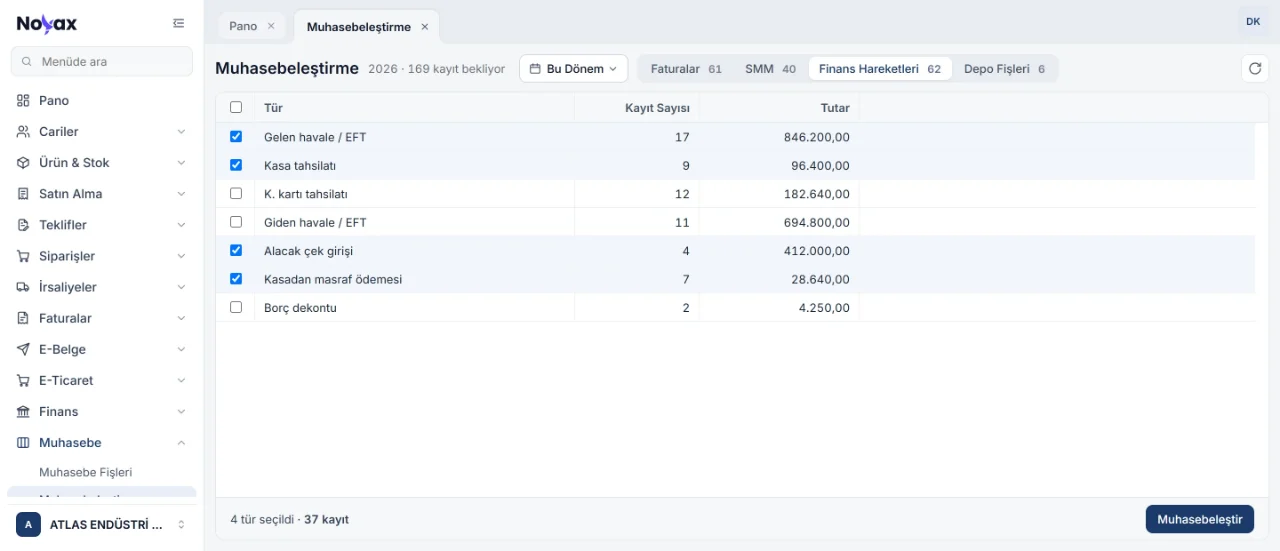
- Accounts come from links. You define once in the accounting links which account customers, products, VAT rates, cash registers, bank accounts and expenses go to. A record whose account cannot be found is not posted and the preview says why; no half vouchers are created.
- The voucher stays linked to its source. In the invoice, bank, cash and customer lists, right-click › Accounting opens the record’s voucher; if needed you delete the journal entry and post the record again.
- Both sides in one voucher. With the offset voucher you enter customer, cash, bank and expense transactions in one voucher that is posted to the books and to pre-accounting at the same time; you never enter the same transaction twice.
- Reports in the same place. The trial balance, ledger, journal and period-end operations are in the accounting menu; a double-click takes you from the trial balance to the ledger and from the ledger to the voucher.
The details of general accounting are on our general ledger page. Try Noyax free for 14 days: enter your invoices and receipts and see how the accounting vouchers are created from them.
Key Takeaways
- Pre-accounting records a business’s daily transactions document by document: customers and suppliers, invoices, cash, bank, cheques and notes, stock.
- General accounting posts the same transactions to the statutory books with double-entry bookkeeping and the Uniform Chart of Accounts; the trial balance, balance sheet and income statement come from it.
- A customer’s balance in pre-accounting and the balance of its account in general accounting must always be the same.
- Commercial companies and sole proprietorships above the thresholds keep their books on the balance-sheet basis and need general accounting; those keeping an operating account book or a self-employment earnings book do not.
- Every business needs pre-accounting. When both sides are kept in one program, a transaction is entered once and the balances agree.
Frequently Asked Questions
What is pre-accounting?
Pre-accounting is the recording and tracking of a business’s daily commercial transactions with their documents: invoices and delivery notes, customer and supplier accounts, receipts and payments, cash, bank, cheques and notes, expenses and stock.
What is the difference between pre-accounting and general accounting?
Pre-accounting is for the business’s own tracking and runs on documents; general accounting turns the same transactions into double entries in the accounts of the Uniform Chart of Accounts and produces the statutory books and financial statements. Pre-accounting is usually done by the business, general accounting by an accountant or the accounting department.
Is pre-accounting software enough?
If you keep an operating account book or a self-employment earnings book, you do not need general accounting, and pre-accounting software is enough for day-to-day tracking. If you are a company keeping books on the balance-sheet basis, you also need general accounting; your accountant can keep it in their own program, or you can keep it in the same program as your pre-accounting.
Do you need an accountant for pre-accounting?
No. Pre-accounting is the business’s own work; it is kept by the people who issue the invoices, collect the payments and manage the stock. For the statutory books and tax returns, most businesses work with an accountant.
Which reports does general accounting produce?
The journal, the general ledger (defteri kebir), the trial balance, account ledgers, the balance sheet and the income statement. The figures for VAT, withholding, provisional tax and annual income or corporate tax returns also come from the general accounting records.
Do businesses with an operating account book do general accounting?
No. The operating account book is a single-entry book listing income and expenses; no chart of accounts and no balance sheet are used. These businesses still keep pre-accounting to track receivables, payables and stock.